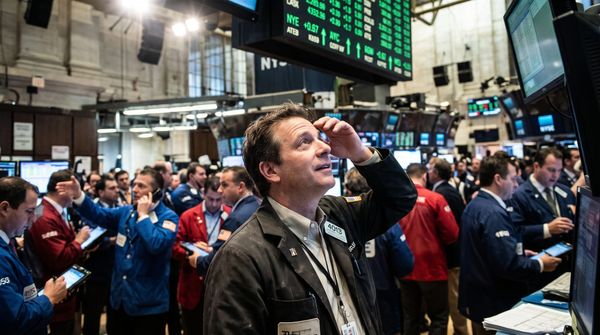
September's Producer Price Index came in at +1.3% for the month — more than double the 0.5–0.6% consensus — the biggest single-month jump since March 2022. Year-over-year wholesale inflation is now running at 6.3%, versus the 5.3% expected, a level not seen since December 2022. Energy drove the headline: gasoline wholesale up 20.3%, diesel up 21%, crude oil up 28.3% in a single month. The December Fed meeting just got a lot more complicated.

|
||
|
||
| Governments around the world spend more than they collect. They have for decades. Here's what that looks like, and why A.I. may make it much worse. | ||
|
||
|
||
|
||
|
||
| Since 1971, when the dollar's link to gold ended, shortfalls like these have been covered with new debt and new money. That pushes prices up, which pushes wages up, which pushes costs up again. A.I. promises to break that loop by removing the worker. But workers are who pay the bills. If paychecks shrink, the gap may grow, and history suggests how it tends to get filled. |
||
|
||
| Our free guide, A.I. Wrecked World, walks through the full chain with sources, plus where physical gold and silver have historically fit when the dollar loses ground. | ||

|
||
| ➤ Get your free copy of A.I. Wrecked World | ||
| No cost. No obligation. Instant digital delivery. | ||
| Paid advertisement for American Sovereign Bullion LLC. Not individualized investment, tax or retirement advice. Figures are attributed to the Congressional Budget Office, the International Monetary Fund and the World Gold Council; projections are estimates, not predictions. Scenarios are risk frameworks, not forecasts. Precious metals fluctuate in value and can decline. Past performance does not indicate future results. |
The Bureau of Labor Statistics released September's Producer Price Index on Thursday morning. The headline: 1.3% month-over-month, the largest single-month increase since March 2022. The year-over-year read is 6.3% — the highest since December 2022. Both numbers blew past forecasts by roughly double. The consensus had called for 0.5–0.6% on the month and 5.3% annually. These are not rounding errors. They are a fundamental reset of the wholesale inflation picture heading into the final two months of the year.
Energy carried the headline. Wholesale gasoline surged 20.3% in September. Diesel gained 21% at the wholesale level. Crude oil was up 28.3% for the month. The core PPI — which strips out food and energy — came in at +0.7% month-over-month and +5.0% year-over-year. That core read is not benign. It tells you the energy shock is not the whole story. Services, trade margins, and transportation costs are all running hotter at the producer level than the retail numbers would suggest. The pipeline from producer prices to consumer prices has a lag of roughly two to four months. What happened at the wholesale level in September begins showing up in the CPI prints for November and December.
"Cobots" Are Transforming This $1T Market
They're not replacing humans; they're working with them. That's the promise of "cobots," or collaborative robots.
In a robotics market NVIDIA CEO called "one of the largest industries ever," this segment's projected to grow 12X by 2035, topping $85B.
Miso Robotics is proving its value in the $1T fast-food industry. And the price you see today won't last.

Miso's Flippy Fry Station robot boosts restaurant profits up to 4X, already logging 200K+ hours in live kitchens for brands like White Castle.
Now, Flippy's entering college campuses, NBA arenas, and another national burger chain to unlock even more of its $4B/yr revenue potential.
Best of all? Flippy is just one piece of Miso's tech platform that's modernizing restaurants. Imagine how valuable the whole thing could be — and imagine explaining to yourself why you waited to find out.
This year alone, Miso made two major asset acquisitions, adding big-name customers like Jersey Mike's and growing its patent portfolio 10X overnight.
44,000+ people already moved before this went mainstream. The window that let them in at today's price is still open. They're not the only ones, either. Industry powerhouse Ecolab invested, too.
This is it — not "soon," not "this quarter." Right now, before the price resets. $5.60/share. After that, this price is gone — no exceptions.
Miso Robotics is offering securities through the use of an Offering Statement that has been qualified by the Securities and Exchange Commission under Tier II of Regulation A. A copy of the Final Offering Circular that forms a part of the Offering Statement may be obtained from: invest.misorobotics.com/
The month of September is doing a lot of work in this number. Brent crude averaged around $90 in September following geopolitical events in the Middle East — the same spike that drove the September CPI gasoline line that we covered two days ago. The PPI is confirming from the other end of the supply chain what the CPI showed at the retail level: the energy shock was real and large, and it has not been fully absorbed. What the PPI adds is the wholesale dimension — the cost to move goods, refine fuel, and transport products that has not yet shown up in prices consumers pay at the register. Those costs are in the pipeline now.
In 1973, a radical White House policy triggered a historic gold rush. Trump's rumored new Executive Order is about to do it again.
When the government severed the dollar's tie to gold in the 1970s, everyday Americans watched their purchasing power collapse. But a small group of prepared investors made generational wealth as gold prices skyrocketed.
Fast forward to today. With Jerome Powell out and Trump allegedly preparing a controversial "Financial Executive Order" to bypass the Fed and pump the market, the stage is set for an even bigger dollar shock.
Top analysts warn inflation will explode. But here is the good news: you don't need to hoard expensive physical bullion to shield yourself.
There is a little-known market loophole that essentially lets you capitalize on this crisis like you are "buying gold at 1973 prices" right before the massive surge.
Click here to discover the "1973 Gold Loophole" and bulletproof your savings before Trump signs the order
This is an advertisement.
If you no longer wish to receive promotional messages from this advertiser, please unsubscribe below. Or write to: 5005 Lyndon B. Johnson Fwy. Suite 350 Dallas, TX 75244
This number arrives two days after the September CPI came in at 3.7%, with gasoline retail up 9.1%. The CPI and PPI are now telling the same story from different vantage points: September was an energy shock, and the shock was large. The producer-level data confirms the retail data was not a fluke. It also confirms the pipeline pressure — what retailers paid wholesale — has not yet fully passed through to consumers.
The question now is whether October energy prices — lower, on the surface, with Russian diesel deals and Iran pledges — are enough to reverse the September momentum before the November CPI lands in mid-December. If October crude and wholesale fuel retrace meaningfully, the pipeline pressure eases and the December pause is back on the table. If October holds near September levels, the November CPI will be hot, and the December 8 meeting becomes a decision the Fed has to make with deteriorating data — not improving data — as the backdrop. For a pre-retiree building fixed income around a December rate environment, the next four weeks of energy data are not background noise. They are the decision.
"I spent thirty years auditing freight contracts. The rate you negotiate going into the year is the rate you live with — until it isn't. A shipper who ignores what's happening at the origin point always gets surprised when the invoice comes due. The PPI is the origin point. What it showed Thursday is that the cost side of the economy is running hot at the source. Consumers haven't seen all of it yet. That bill is still in transit."
Confirmed: September PPI headline +1.3% MoM, +6.3% YoY (Bureau of Labor Statistics, released Oct. 16, 2026). Consensus forecast: +0.5–0.6% MoM, +5.3% YoY. Core PPI (ex-food and energy): +0.7% MoM, +5.0% YoY. Wholesale gasoline: +20.3% MoM. Wholesale diesel: +21.0% MoM. Crude oil at producer level: +28.3% MoM. Prior comparable prints: headline MoM last this large in March 2022; headline YoY last this high in December 2022.
Context: September CPI (released Oct. 14): headline +3.7% YoY, gasoline retail +9.1% MoM. December Fed meeting: December 8, 2026. October PPI release expected mid-November. November CPI release expected Dec. 10–11. PPI-to-CPI passthrough lag: typically two to four months for energy; two to six months for services and trade margins.