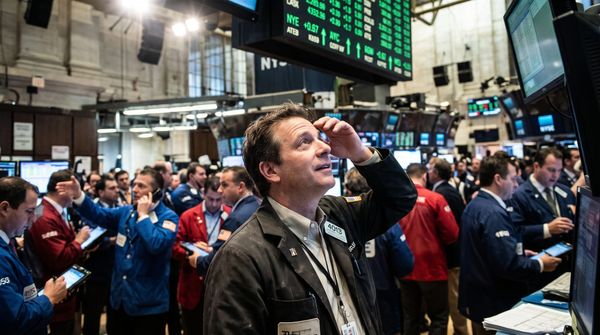
Jensen Huang has resigned as CEO of Nvidia, effective immediately, ending a 33-year run at the company he co-founded and built into the defining face of the AI boom. CFO Colette Kress will serve as interim CEO while the board searches for a permanent replacement. Nvidia shares fell more than 10% on the news — and because Nvidia is one of the largest single holdings in the S&P 500, the drop is hitting index funds and retirement accounts across the country. Some investors are already looking beyond AI chips for the next source of growth. Others are moving toward the kind of assets that have historically held their value when technology leaders stumble.
Jensen Huang is not just a CEO. He is the personality that the market used to price Nvidia's premium. When analysts and institutional investors modeled Nvidia's future, they were not simply modeling GPU demand curves and data center spending cycles — they were modeling Jensen's ability to stay ahead of every competitor, anticipate the next architectural shift, and personally close the deals that made Nvidia the indispensable infrastructure layer of the AI economy. That human capital is not on the balance sheet. It cannot be transferred to an interim CEO. And the market, which has spent three years pricing Nvidia as though Jensen's judgment was a permanent competitive moat, is now repricing that assumption in real time. A 10% drop in one session is not panic. It is the market doing arithmetic.
132,000+ ounces of gold. Approximately 5 million ounces of silver.
And the company behind the project is offering shares at $0.20.
Meet Star Gold Corp.
Its focus? Bringing the 100%-owned Longstreet Gold-Silver Project in Nevada toward production.
The company's reported groundwork already includes:
- 400+ drill holes
- 132,000+ ounces of gold in mineral resources
- Approximately 5 million ounces of silver
- 9 exploration targets across the property
And according to Star Gold, the currently defined resource occupies less than 2% of its total land package.
The project's Preliminary Economic Assessment estimates:
$87 million pre-tax net present value · ~30,000 oz peak annual gold production · 1.7-year project payback period
That payback estimate applies to the project — not your investment.
The next chapter is moving from development toward production. Permitting. Financing. Construction. Those milestones remain ahead.
Right now, investors can participate in Star Gold's offering at $0.20 per share, with a $1,000 minimum investment. Qualifying investments also receive bonus shares and physical precious-metal perks, depending on investment size and offering terms.
Explore the Longstreet project and Star Gold's $0.20 share offering →
This is a paid advertisement for Star Gold Corp. Regulation A offering. Please read the offering circular at invest.stargoldcorp.com
The question now is whether Nvidia's business is durable without Jensen or whether the business was, in a meaningful sense, Jensen. The bulls will point to the product roadmap — Blackwell, Rubin, the data center pipeline — as evidence that the company's competitive position is structural rather than personal. The bears will point to the fact that Jensen personally maintained relationships with every major hyperscaler CEO, personally negotiated the supply allocations that defined who got GPUs and when, and personally shaped the narrative that allowed Nvidia to charge premium margins on hardware that competitors are spending billions to replicate. Those are not functions that transfer to Colette Kress on day one. The board has a permanent search to run. And until a credible permanent CEO is named, every analyst model that assumed Jensen continuity is now a liability.
Some of the capital leaving Nvidia today is not going to competitors — it is going somewhere else entirely. The past three years trained investors to treat AI as synonymous with GPU chips, and GPU chips as synonymous with Nvidia, and Nvidia as synonymous with Jensen Huang. That chain of equivalences is broken now, at least at the final link. Investors who want AI exposure without the Jensen-specific risk are looking at the broader ecosystem — cloud providers, software companies, the biotech sector where AI is colliding with drug discovery in ways that may ultimately matter more to human life than any data center. The rotation out of Nvidia and into adjacent growth stories has been underway since the market opened this morning.
Medicine was not scientific for most of human history. It was closer to ritual.
Bloodletting, leeches, maggots, holy water. No germ theory. No molecular understanding of disease. No precision tools.
Today, we've advanced enough to actually combat cancer's reign of terror. And just like any other endeavor, the biotech companies that solve these colossal biological challenges rightly reap massive financial rewards.
Consider Moderna: it popped almost 200% in 24 hours as news of a successful phase 3 trial for its cancer drug was announced. Merck added $43 billion to its market cap on the same news.

We are entering what I call Biotech's Ignition Point.
The free-fall in AI computing costs is now fusing with advanced AI models and 24/7 autonomous wet labs. Development timelines are reportedly collapsing by up to 80%. Early-stage clinical success rates are reportedly skyrocketing to as high as 90%. Previously "undruggable" diseases are suddenly wide open.
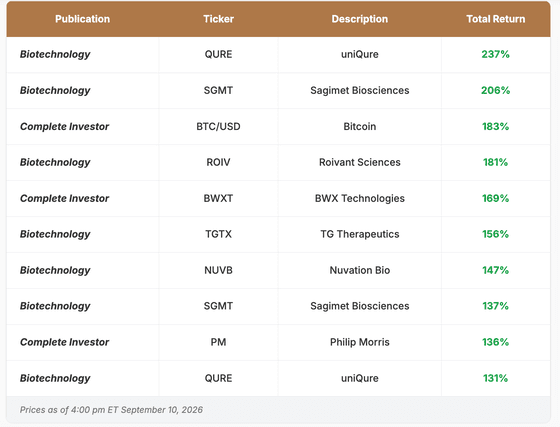
Six of the top 10 highest-performing positions at Porter & Co. right now are from the biotech sector — including 237% on uniQure, 206% on Sagimet Biosciences, and 156% on TG Therapeutics.
We delivered those gains before this new Ignition Point has even truly begun.
I recently recorded an urgent, step-by-step broadcast outlining exactly how this Ignition Point is unfolding — including the name and ticker of my #1 biotech stock to buy right now.
Click here to stream the Ignition Point broadcast immediately.
Good investing,
Porter Stansberry
The retirement account story is the one most financial media will underplay. When a company the size of Nvidia drops 10% in a single session, the damage is not confined to active investors who chose to own NVDA. It is embedded in every S&P 500 index fund, every target-date retirement fund, every 401(k) that holds a broad market index. Nvidia's weight in the S&P 500 is large enough that a 10% drop in NVDA moves the index by a material amount on its own. For the tens of millions of Americans who have never owned a single share of Nvidia directly, this morning is arriving in their retirement account balance without warning and without choice. That is the structural consequence of a market that allowed one company — and one person — to become this large a share of the index.
Only 999 complimentary copies of this new Gold Guide were set aside for this release.
And each one explains something most Americans still don't know:
Trump has spoken publicly about a new American "golden era." He has also raised questions about the gold held inside Fort Knox.
Meanwhile, Washington lists approximately 8,133 tonnes of gold on its books, using a statutory value set decades ago and far below today's market price.
Claim my FREE copy here.

While most Americans wait for an official announcement, major financial institutions continue studying gold and central banks have sharply increased their holdings.
The smart money isn't waiting to understand the possibility. They're examining it now.
Inside this complimentary guide:
→ What a possible Trump gold policy could mean
→ Why central banks have accelerated their gold purchases
→ Why America's 8,133 tonnes of gold are back in focus
→ How eligible retirement funds may be moved into physical gold through a Gold IRA
No executive action is guaranteed. But most people miss major monetary events because they wait until the story is already national news.
Once these 999 complimentary copies are claimed, this free release may close.
Read the guide. Review the facts. Then decide for yourself.
Reagan Gold Group does not provide financial, legal, or tax advice. This material is for educational purposes only and should not be considered investment advice. All investments carry risk, including loss of principal. Past performance is not indicative of future results. Please consult a licensed financial advisor before making investment decisions.
"I've been watching founders leave companies my whole career. Usually it's planned — there's a transition, there's a successor who has been groomed, there's a narrative the board controls. 'Effective immediately' is different. That phrase tells you something went wrong with the planning, or there was no planning, or someone decided the planning was no longer possible. Jensen Huang built Nvidia from nothing into the most important technology company of the AI era. He deserved to leave on his own terms, with a year of transition and a chosen successor. 'Effective immediately' is not that. And the market knows it."
Jensen Huang resignation, Colette Kress interim CEO: Nvidia press release, November 12, 2026.
Nvidia shares −10%+: Bloomberg market data, November 12, 2026.
S&P 500 index impact: Nvidia weighting per S&P Dow Jones Indices, November 2026 rebalance.