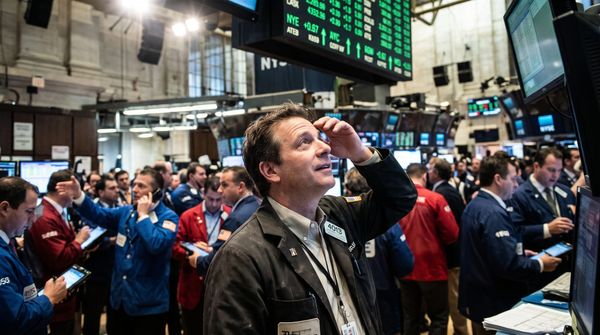
Gold posted its best single-day gain since August on Wednesday — up roughly 3.3% — and by Thursday morning had pushed to $4,130–$4,144 per ounce. Silver followed to around $53. The dollar fell to its weakest level since September 30. The 10-year Treasury yield dropped to 4.85–4.89%. Investors are rotating into hard assets after the election result, pricing in a divided government that fights over debt ceilings rather than resolves them. The Fed is not moving to cut: the market still expects a rate hike in December, not a reduction. This is not a rally built on optimism. It is a rally built on uncertainty.
Democrats now control both chambers of Congress.
There's one major money issue the election didn't solve.
America's debt ceiling.
Washington may face another fight over federal borrowing in 2027.
And with Congress and the White House controlled by different parties, reaching a deal could prove difficult.
Here's the question for anyone planning to retire in the next decade:
Does your retirement plan have room for assets beyond stocks and bonds?
Physical gold and silver may offer one way to spread risk, though prices can fall and costs matter.
This free guide explains what retirement savers should know before adding precious metals to an existing plan.
Gold at $4,140 is not a price that reflects panic — it reflects a methodical institutional shift. The move on Wednesday was the largest single-day gain since August, and it happened on volume that suggests real buying rather than speculative positioning. The catalyst was the election result, but the underlying conditions have been building for weeks: the dollar had been weakening since the correction began in October, the 10-year yield had started to roll over from its highs above 5%, and the geopolitical environment had not improved. The election result removed the final uncertainty that was keeping some investors on the sidelines. Once the result was clear — divided government, debt ceiling fight ahead, no fiscal resolution in sight — the rotation into gold accelerated.
Silver's move to $53 is worth watching separately. Silver tends to lag gold at the start of a precious metals rally and then accelerate once the move is established. The gold-to-silver ratio — currently around 78 — is historically elevated, which means silver has more room to run on a catch-up basis if the rally continues. Silver also has industrial demand components that gold does not: semiconductor manufacturing, solar panels, and EV batteries all require silver in meaningful quantities. A weakening dollar improves the economics of those industries globally, adding a demand tailwind on top of the safe-haven bid.
On Tesla's Q2 2020 earnings call, Elon Musk said:
"Any mining companies out there, please mine more nickel. Okay. Wherever you are in the world, please mine more nickel… Tesla will give you a giant contract for a long period of time."
And that demand goes way beyond EVs.
SpaceX rockets cannot fly without nickel-tungsten superalloys. With a 6,192°F melting point, tungsten keeps Raptor engine superalloys, semiconductors, and armor-piercing shells from failing under extreme heat.
With China controlling 84% of supply and the Pentagon banning Chinese tungsten, America has zero domestic production — sending tungsten prices up over 500% in the past year.

In response, United States Tungsten is reopening North America's largest historic tungsten facility in North Carolina:
And even better — they're already in talks with the U.S. government about supply contracts.
You can still get in before those deals are priced in.
Right now, you can still invest at $2.25/share (plus up to 21% bonus shares).
Disclaimer: This is a paid advertisement for United States Tungsten Corp's Regulation CF offering. Please read the offering circular at invest.unitedstatestungsten.com
The debt ceiling context matters for understanding the gold move. With Democrats controlling Congress and Trump in the White House, the 2027 debt ceiling negotiation will be a confrontation rather than a negotiation. The two parties have incompatible positions on spending. Democrats will not accept deep cuts; Trump will not sign a clean increase without concessions. The last time Washington came close to a genuine default — 2011 and again in 2023 — gold rallied sharply in the weeks leading up to the deadline. Investors are beginning to position for a replay of that dynamic, twelve to eighteen months out. The election result did not create that risk. It made it more certain.
The Fed's December posture adds a layer of complexity. The market is not pricing a rate cut — it is pricing a hike. That means the gold rally is not being driven by the expectation of falling real rates, which is the conventional mechanism for gold outperformance. It is being driven by currency debasement risk and political uncertainty directly. That is a different and in some ways more durable driver: rate expectations can reverse quickly on a single inflation print, but fiscal uncertainty does not resolve until Congress acts. And Congress is not going to act quickly.
Democrats won the Senate, and starting Jan 3, every nomination to the Federal Reserve runs through a new majority.
The fight over who controls the Fed was already loud: the Supreme Court kept a Fed governor in her seat by a single vote, and the current chair won the most divisive confirmation vote in the job's history.
Now a third player joins the fight.
With the Fed cutting scheduled rate decisions from 8 a year to 6 by 2028, each vote matters more for your savings.
When politics gets this loud, Safe Money Report's approach is quiet: protect your purchasing power first, then grow it.
Get Martin Weiss's plan to take back control
"I've been watching gold for forty years. The moves that last are not the ones driven by fear — they're the ones driven by math. And the math right now is straightforward. You have a government that cannot agree on how to pay its bills, a central bank that is raising rates into a slowing economy, and a currency that has been losing ground for weeks. That is not a panic. That is a structural condition. The last time I saw this combination was 2011. Gold went from $1,500 to $1,900 in four months. I am not making a price prediction. I am saying: I know what this looks like, and I am not surprised by what happened Wednesday."
Gold price and daily gain: Bloomberg commodity data, November 4–5, 2026. Spot gold +3.3% Wednesday; Thursday morning range $4,130–$4,144/oz. Best single-day gain since August 2026.
Silver price: Bloomberg commodity data, November 5, 2026. Silver spot approximately $53/oz.
10-year Treasury yield: Bloomberg bond market data, November 5, 2026. Range 4.85–4.89%, down from above 5% in prior sessions.
US Dollar index: Bloomberg FX data, November 5, 2026. Dollar index at weakest level since September 30, 2026.
Fed December expectations: CME FedWatch Tool, November 5, 2026. Market pricing a rate hike, not a cut, for December meeting.