
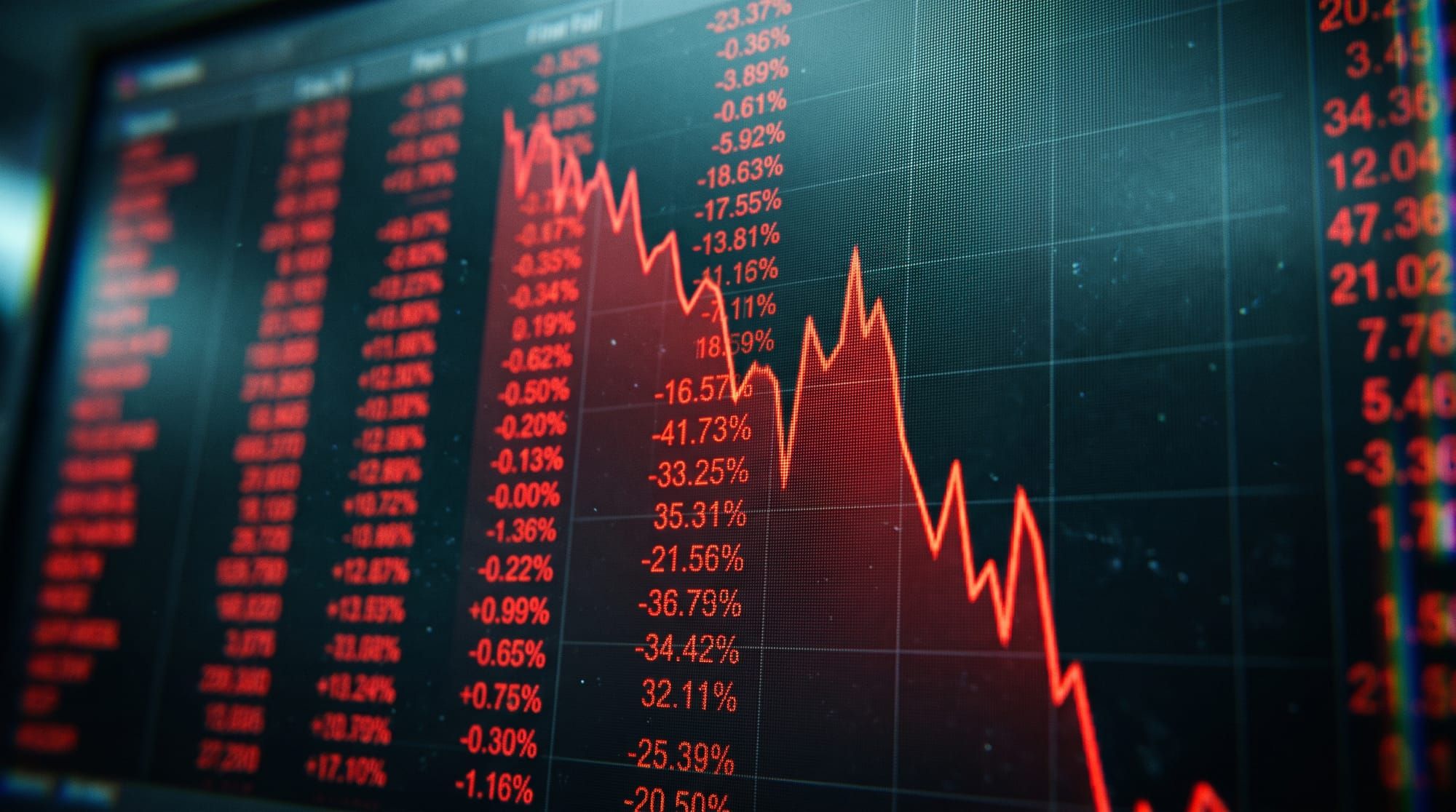
Wall Street's AI trade got its first real stress test Thursday. The fear driving the selloff was not an earnings miss or a macro surprise — it was a political thesis: that a Democratic Congress will slow, block, or raise the cost of the data center construction boom that the entire AI infrastructure trade depends on. The Philadelphia Semiconductor Index fell 12.25%. Nvidia shed roughly $450 billion in market cap in a single session. Data center operators dropped more than 14%. Referenda held alongside Tuesday's election showed voters rejecting data center projects in 40 of 41 local votes. No law has been passed. The new Congress does not convene until January 2027. The market sold the fear, not the fact.
Editor's Note: Porter Stansberry's bombshell exposé is now live. Sitting down with financial reporter Kimi Weintraub, he reveals why he believes President Trump is secretly replacing the U.S. dollar – and why the story could break wide open on December 14. He also names his No. 1 move to help you prepare.
Watch it here before you read another word.
In the autumn of 408 A.D., a Gothic king named Alaric marched his army to the walls of Rome and simply waited.
He didn't need to storm the city. He cut off the grain barges coming up the Tiber, and within weeks the richest city on Earth was starving.
His price for leaving was thousands of pounds of gold, tens of thousands of pounds of silver, and three thousand pounds of pepper.
Rome no longer had it.
So the Senate stripped the temples and melted down the statues of their gods to pay him. According to the historian Zosimus, one of them was Virtus, the goddess of courage, and once she went into the furnace, whatever courage the Romans had left went with her.
Two years later Alaric came back and walked straight in – for the first time in eight hundred years, Rome was sacked by a foreign army.
Rome had been brought to its knees because it allowed its money to go to ruin. For two hundred years before Alaric arrived, emperor after emperor had shaved the silver out of the denarius to pay for their wars – until the coin that was once trusted from Britain to Babylon was a lump of bronze with a thin silver wash.
By the time the Goths reached the gates, Rome's walls were still standing, but its money had already given way.
Today, America faces its own barbarians at the gate.
China's Silent Siege
The new Barbarians aren't camped outside Washington – like Alaric, they don't need to storm the capital, they're simply waiting for the money to fail.
China has slashed its holdings of U.S. Treasuries by more than 45% from their peak.
It controls the vast majority of the world's refined rare earths, the metals without which no advanced chip or weapon can be built.
And it is building gold vaults in Hong Kong and payment networks that let nations trade without ever touching a dollar.
Beijing is cutting off the grain barges, and now it's waiting at the walls.
Trump's Secret Dollar Reset
Instead of melting down the statues, President Trump is trying to give the world a new reason to need the dollar.
Working hand in hand with the likes of Elon Musk, Mark Zuckerberg and Sam Altman, he is racing to lock the physical foundation of artificial intelligence (the minerals, chips, energy and data centers) under near-exclusive American control.
That's why the government has taken billion-dollar stakes in obscure mining companies, why the President negotiated a reported $500 billion of Ukraine's minerals, and why he refuses to let go of Greenland.
Seen together, I believe these emergency moves are the foundations of a new monetary order, with the dollar anchored not to oil but to what I call the AI Matrix.
The companies at its chokepoints are already moving the way ExxonMobil and Lockheed did half a century ago. Vertiv is up more than 500% since 2024, GE Vernova nearly 700% and Arista Networks more than 750% since 2021.
I recently laid out the full story for financial reporter Kimi Weintraub. I explain why December 14 could be the moment this new order is revealed — and I share the five companies I believe sit at its narrowest chokepoints.
Good investing,
Porter Stansberry

The scale of Thursday's move requires some context. A 12.25% drop in the SOX index is the kind of number that happens perhaps three or four times in a decade. The last comparable single-session selloff in semiconductors was October 2022, when the Biden administration announced export restrictions on advanced chips to China. That move had a concrete, quantifiable impact on the revenue of every company in the index. Thursday's catalyst was different: it was a projection, a fear about what a Democratic Congress might do over the next two years. No committee has held a hearing. No bill has been drafted. No vote has been scheduled. The market priced two years of potential regulatory risk in a single afternoon.
The referendum data is real, and it deserves attention. Voters in 40 of 41 local referenda voted against data center projects on Tuesday. That is a striking number, and it reflects genuine community opposition to the land use, power consumption, and noise that large-scale data center construction brings. But local referenda are not federal legislation, and the history of infrastructure buildouts in America suggests that federal permitting reform — which has bipartisan support — tends to override local opposition when strategic economic interests are at stake. The comparison to cell tower buildout in the 1990s is instructive: communities across the country voted against towers, and the towers went up anyway.
The critical thing to understand about Thursday's selloff is what did not happen. Microsoft, Google, Meta, and Amazon have not revised their AI capital expenditure guidance. The hyperscalers collectively committed to spending north of $500 billion on AI infrastructure over the next several years; that commitment did not change on Thursday. What changed was the market's confidence that the physical infrastructure — the data centers, the power grids, the cooling systems — can be built on the originally planned timelines. That is a real concern, but it is not a binary one. Regulatory friction raises costs and extends timelines; it does not necessarily stop construction. The market's response priced the worst-case outcome — permanent blockage — when the realistic outcome is probably delayed and more expensive construction.
The power angle is worth watching separately. Data centers require enormous amounts of electricity, and the electricity constraint is arguably more binding than the permitting constraint. Utilities in Northern Virginia, the largest data center market in the world, have already told customers they cannot guarantee new power connections until 2028. That problem predates the election and is not solved by either party. The companies that own or build power generation assets — natural gas peakers, nuclear plants, small modular reactors — may ultimately benefit from regulatory uncertainty around data centers, because it increases the premium on power assets that already have permits and connections. The energy trade may prove more durable than the semiconductor trade in this environment.

My name is Jeff Brown, founder and CEO of Brownstone Research.
Something could happen on November 11 that catches most investors completely off guard.
A tiny stock — trading at under $1 — could announce a supply deal with Elon Musk.
If that happens, the move could be fast. Similar partnership announcements have sent Musk suppliers soaring by as much as 395% in a single day.
Yes, Thursday was ugly. The AI selloff hit the entire sector. But the AI money has not gone anywhere — Musk alone is spending $110 billion on AI infrastructure. The selloff did not change that number.
This company holds the keys to the future of Musk's AI masterplan. It's even helping roll a new Cybercab off the line every 10 seconds.
The insider I interviewed believes you could potentially see 39x your money in under two years.
But you need to see this before November 11. After that, you could miss out entirely.

Colombia opened an $800 million deep-water port. Green Coffee Company became the first private coffee exporter to ship through it.
No regulators. No Congress. No referenda. Just a shorter route from Colombian farms to American shelves.
Green Coffee Company has already reached 3,000+ retail locations, generated $26M in 2025 revenue, and been backed by individual investors with $120M+.
Pre-IPO shares are now available at $1.15, minimum investment $1,000.50, with up to 20% bonus shares.
This is a paid advertisement for Green Coffee Company's Regulation A offering. Please read the offering circular at invest.greencoffeecompany.com. No IPO is agreed, guaranteed, or scheduled, and plans may change at any time.*
"I spent thirty years in logistics. The one thing I learned is that infrastructure always gets built. It gets delayed, it gets rerouted, it gets built in different states than originally planned, it costs twice what anyone projected. But it gets built. Because the people spending the money have more leverage than the people trying to stop it. I don't know if the AI data center boom is going to be as big as the bulls say it is. But I'd bet that the data centers get built. That bet is now on sale."
Semiconductor index decline: Philadelphia Semiconductor Index (SOX), November 5, 2026. Single-session decline of 12.25%.
Nvidia market cap loss: Bloomberg market data, November 5, 2026. Approximately $450 billion in market capitalization lost in a single session.
Data center operator declines: Bloomberg sector data, November 5, 2026. Major data center operators declined more than 14% on average.
Referendum data: Reuters, AP, local election reporting, November 5, 2026. Voters in approximately 40 of 41 local referenda voted against data center construction projects.
Congress convening date: U.S. Congressional calendar. New Congress convenes January 3, 2027. No legislation has been passed or introduced.