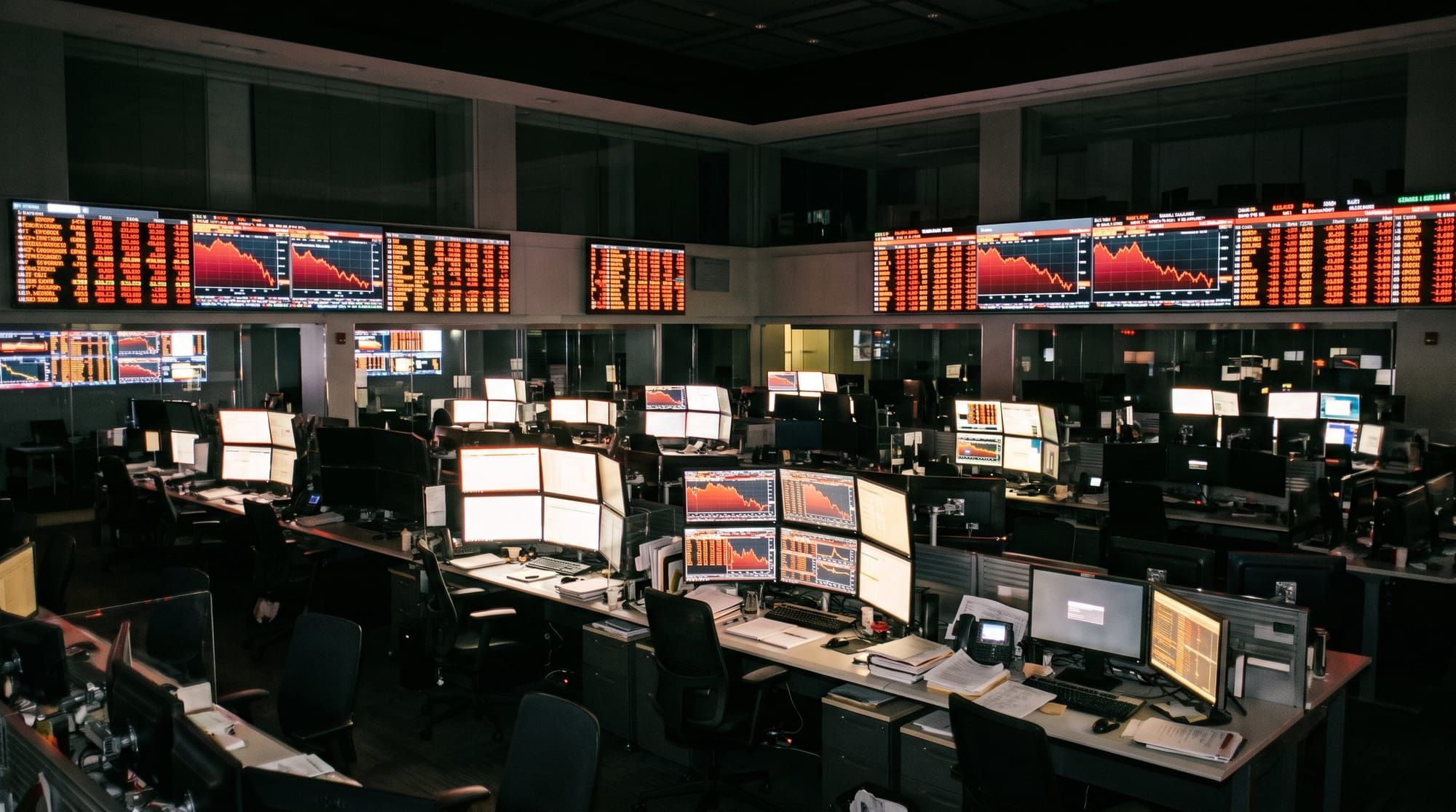
The Nasdaq-100 officially entered correction territory Monday, closing more than 10% below its all-time high. The bounce that started the week never held. Apple reported after the close and fell roughly 4% on weak margin guidance — the one company the market was counting on to stabilize the story delivered instead another reason to sell. Palantir dropped 8% despite beating estimates. The market is not punishing bad numbers anymore. It is punishing the sector. The Dow added 0.41% on oil's continued slide, the S&P 500 lost 0.51%, and the VIX held near 21.4 — elevated, but not panicked. Today is Election Day.
Another stock. Another fund. Another bet on prices going up?
Before you add anything else to your portfolio, consider this:
How much of it needs a rising market to work?
That's the question behind Tuesday's live investor briefing.

A former Wells Fargo investment executive will examine 12 trading algorithms designed to pursue opportunities in both rising and falling markets.
The attention-grabber? A claimed 2,232% compounded return since 2020, presented as hypothetical performance.
But the bigger investor question is:
Could this approach bring something different to your portfolio — and at what risk?
See the strategy. Understand the trade-offs. Ask your questions live.
The Palantir result is the more revealing data point from Monday. The company beat earnings estimates — revenue up, guidance raised — and the stock dropped 8%. That is a clean signal of where institutional money stands right now: it is not evaluating individual reports anymore. It is reducing technology exposure as a category. When a company that exceeds expectations on every metric loses 8% of its value in a single session, the message is that the sell decision was made before the earnings call opened. Valuation was the problem — Palantir had been trading at multiples that embedded years of growth — and the broader correction gave funds the cover to take it down without it looking like a company-specific call.
Apple is more complicated. The company's gross margin guidance came in softer than analysts expected — a signal that the cost of integrating AI features into hardware is showing up in the income statement. The AI model running locally on an iPhone is not free to build or maintain, and Apple is absorbing that cost at a moment when the market is already suspicious of technology companies spending heavily on AI without visible return. The iPhone supercycle thesis — the idea that AI features would drive an upgrade wave — has not yet materialized in the revenue line. That gap between the promise and the numbers is what the 4% drop represents.
In 1961, a robotic arm called Unimate started welding car frames at General Motors in Ewing Township, New Jersey.
By 1982, most of the assembly line was machines.
California boosted its fast-food minimum at $20 an hour in April 2024.
Since 2025, at least 16 restaurants have closed in one California county, per the Fresno Bee.
Restaurant workers file heat-burn claims at 7.4 times the rate of every other American industry, per the Centers for Disease Control (CDC).
Twenty-nine percent of those burns come from fats and oils.
Miso Robotics is building the solution that makes the fry station safer.
See the Flippy Fry Station →
Miso's third-generation Flippy robots are cooking in real commercial kitchens today.
For the people running the kitchen, the benefit is practical.
Flippy takes over the repetitive work at the hot-oil station. According to Miso, it can cook twice as fast as human fry cooks and handles up to 100+ baskets an hour — helping a busy kitchen keep orders moving while employees focus on other tasks.
Miso says the system installs overnight and staff can train in less than a day. The robot takes on the fryer routine; the restaurant team learns to work alongside it.
The robot runs on NVIDIA's Isaac Manipulator platform. Same platform that Figure AI and Boston Dynamics build on.
In October 2024, NVIDIA integrated it with Miso's motion stack.
In May 2023, Ecolab made a strategic investment in the company.
In June 2026, Miso closed on acquiring hundreds of patents from Zume Pizza, the SoftBank-backed pizza-robotics company that raised roughly $375 million before it shut down in 2023.
Explore Miso's technology and offering →
In September 2026, Goldman Sachs raised its 2035 humanoid-robot forecast from $38 billion to $138 billion.
Miso Robotics is now open to individual investors like you under Reg A+.
Common stock. Share price: $5.60. Minimum investment: $1,052.16.
P.S. In 1961 you had to be General Motors to buy the first Unimate. Today, you can invest in the company behind Flippy with a minimum investment of $1,052.16.
Important: This promotional email summarizes information from Miso Robotics' investment materials and is not investment advice. Investing in private companies involves substantial risk, including possible loss of principal, illiquidity, dilution and the possibility that no exit occurs. Miso Robotics shares are not publicly traded. Any potential future IPO is uncertain and not guaranteed. Performance, patent and market figures are Miso's stated projections and claims, not guarantees. Miso Robotics is offering securities through the use of an Offering Statement that has been qualified by the Securities and Exchange Commission under Tier II of Regulation A. Qualification does not constitute approval or endorsement. A copy of the Final Offering Circular that forms a part of the Offering Statement may be obtained from: invest.misorobotics.com/
The Dow's 0.41% gain on a day when the Nasdaq entered correction is not a coincidence — it is a rotation signal. The Dow is heavy in industrials, energy, and financials. All three benefit from the same conditions that hurt technology: oil falling reduces input costs for manufacturers, lower tech valuations free up capital that has to go somewhere, and a steepening yield curve favors bank lending margins. The two indexes moving in opposite directions on the same day is the market's mechanism for shifting money between sectors without taking it out of equities entirely. Whether that rotation becomes structural — meaning sustained over weeks — depends on what Wednesday's election results say about regulatory and fiscal policy for the next two years.
The VIX at 21.4 tells a specific story. It is above the long-term average of around 18, which means the options market is pricing in above-normal uncertainty. But it is well below the levels — 30, 35, 40 — that typically accompany genuine panic or forced liquidation. What 21.4 describes is a market that is nervous and uncertain, but not yet broken. Institutional investors are hedging, not fleeing. The question is whether Wednesday's post-election volatility — whichever direction it goes — pushes that number higher or brings it back toward normal.
If you're near or over 73, this matters.
Most retirees take their Required Minimum Distributions (RMDs) the default way.
In cash.
And that's where the problem starts.
Because taking RMDs the wrong way can mean:
- More taxes for Washington
- Less compounding for you
- A smaller legacy for your family
What most retirees don't realize is that IRS Code 408(m) allows RMDs to be handled differently — in a way that may help protect more of what you've earned.
But timing matters.
Once the distribution hits your account, options shrink fast.
We created a free guide explaining:
- The #1 RMD trap
- Why inflation quietly erodes cash distributions
- How some retirees are repositioning before it's too late
Download your FREE RMD Guide here.
Because the most expensive mistake…
Is waiting until after the check clears.
Allegiance Gold, LLC is not a broker-dealer and does not provide investment, tax, or legal advisory services. No statement in this communication should be construed as a recommendation to purchase or sell any security. Precious metals carry risk and are not suitable for all investors. Past performance does not guarantee future results. Copyright Allegiance Gold, LLC 2026
"In logistics, when a correction hits, the first thing you ask is: did anything structurally change, or did the price just get ahead of itself? What I'm seeing in this tech correction looks like the second one. The businesses aren't broken. Amazon still delivers packages. Google still runs the world's search. Apple still sells a billion devices. What got broken was the narrative — the idea that AI spending would pay off in eighteen months. The market believed it, priced it in, and is now repricing it out. That's uncomfortable, but it's not the same as broken. I've watched a lot of corrections. The ones that turn into bear markets are the ones where the underlying business model fails. I don't see that here yet."
Nasdaq-100 correction confirmation: Bloomberg and Reuters market data, November 3, 2026. Index closed more than 10% below all-time high.
Apple earnings and margin guidance: Apple Inc. Q4 FY2026 earnings release, November 3, 2026 (after close). Gross margin guidance below consensus; stock down approximately 4% in extended hours.
Palantir earnings and stock move: Palantir Technologies Q3 2026 earnings release and Bloomberg market data. Beat on revenue and EPS; stock −8% on valuation concerns.
Dow, S&P 500 Monday close: NYSE and Nasdaq market data, November 2, 2026. Dow +0.41%, S&P 500 −0.51%.
VIX level: CBOE Volatility Index, November 3, 2026 pre-market. Approximately 21.4.