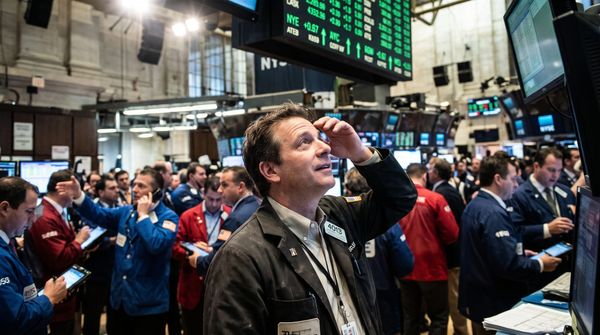
Brent crude surged 2.7% Thursday to $111.8 — the highest price since May — after a drone strike hit the Shaybah complex, the crown jewel of Saudi Aramco's production network. American inventory data poured fuel on the move: U.S. stockpiles fell 3.06 million barrels last week against an 800,000-barrel forecast. Bank of America is warning clients that a genuine supply deficit could arrive within months. The IEA sees tightness persisting through 2027. For anyone still driving to work, this means something specific: gas prices are going back up.

This is the first time in history the FAA has given a personal flying car a path to market.
Doroni started in a garage.
Today it has FAA clearance.
70+ manned test flights completed.
600 customers already reserved one.
That is $240 million in potential revenue before a single delivery.
16,500+ investors are already in.
$45M+ raised. Nasdaq $DRNI reserved.
Morgan Stanley says this market hits $1 trillion by 2040.
The average person loses 9 days a year to traffic.
Doroni is building the alternative.
120 MPH. 100-mile range. Charges at home in 25 minutes.
First deliveries targeted for 2028.
The pre-IPO share price is $3.30.
This is a paid advertisement for Doroni Regulation A offering. Please read the offering circular at https://invest.doroni.io/
What happened at Shaybah matters more than its name suggests. The complex produces roughly one million barrels a day — a meaningful slice of Saudi Aramco's total output — and it is located deep in the Rub' al Khali desert, far from the coastal processing facilities that have been the traditional focus of geopolitical risk. A successful strike there is an escalation in both geography and ambition. Markets priced in a risk premium immediately: Brent moved 2.7% in hours, touching $111.8, a level not seen since May.
The drone strike alone would have moved oil. But the inventory number made it worse. The EIA reported a draw of 3.06 million barrels for the week — nearly four times the 800,000-barrel consensus estimate. That gap is not noise; it reflects genuine demand that analysts had not fully modeled. When supply faces a geopolitical disruption and demand simultaneously shows up stronger than expected, prices move fast and they move together. That is exactly what happened Thursday morning.
If you're near or over 73, this matters.
Most retirees take their Required Minimum Distributions (RMDs) the default way.
In cash.
And that's where the problem starts.
Because taking RMDs the wrong way can mean:
- More taxes for Washington
- Less compounding for you
- A smaller legacy for your family
What most retirees don't realize is that IRS Code 408(m) allows RMDs to be handled differently — in a way that may help protect more of what you've earned.
But timing matters.
Once the distribution hits your account, options shrink fast.
We created a free guide explaining:
- The #1 RMD trap
- Why inflation quietly erodes cash distributions
- How some retirees are repositioning before it's too late
Download your FREE RMD Guide here.
Because the most expensive mistake…
Is waiting until after the check clears.
Allegiance Gold, LLC is not a broker-dealer and does not provide investment, tax, or legal advisory services. No statement in this communication should be construed as a recommendation to purchase or sell any security. Precious metals carry risk and are not suitable for all investors. Past performance does not guarantee future results. Copyright Allegiance Gold, LLC 2026
Saudi Aramco confirmed damage at Shaybah but has not specified the extent of the production impact or a timeline for restoration. The complex processes upwards of one million barrels per day in the heart of the Empty Quarter — one of the world's largest continuous sand deserts — making it both critical to Aramco's output and difficult to defend against aerial attack.
The IEA's October Oil Market Report sees undersupply persisting through at least late 2027, driven by limited spare capacity among Gulf producers and a slower-than-expected ramp of non-OPEC supply. Bank of America raised its Q4 Brent target to $118 Thursday, citing OPEC+ underproduction against quotas and persistent above-trend demand in Asia. Retail gas prices were already running above $3.80 nationally before today's move. A sustained Brent above $110 historically pushes the national average above $4.00 within three to four weeks, per AAA data.
Bank of America revealed your expiration date.
In their Bloomberg interview, said the digital dollar was inevitable.

Their exact words: CBDCs are an "inevitable evolution of today's electronic currencies."
The Federal Reserve has already asked for public comment. The infrastructure is being built as you read this.
Once the digital dollar launches, every transaction you make can be tracked. Your spending could be controlled. Your accounts could be frozen.
China already did this. Nigeria already did this.
But there's still a way to preserve your privacy.
I'm Tan Gera, ex-Wall Street banker and CFA Charterholder.
I left the system when I saw what was coming.
Over 4,500 investors have already used this method to hold assets the government can't freeze and generate yields the Federal Reserve can't touch.
Watch how to access this escape hatch before it closes →
The window is closing.
To your freedom,
Tan Gera, CFA
Decentralized Masters
P.S. Bank of America called the digital dollar "inevitable." Discover the easy method investors are using to escape →
"I've been tracking energy markets since the late nineties. You know what the common thread is every time oil makes a sustained run? It's never just one thing. It's the setup — tight inventory, limited spare capacity — and then the event lights it. Shaybah was the match. The powder was already there. I'm not betting this reverses fast, and I'd be watching the Monday gas number very carefully."
Oil price and percentage change: Reuters and Bloomberg commodity feeds, October 22, 2026. Brent at $111.8, WTI at approximately $107.5, both representing session highs.
EIA weekly petroleum status report: U.S. Energy Information Administration, week ending October 17, 2026. Actual draw −3.06 million barrels vs. consensus estimate of −800,000 barrels.
Shaybah complex details: Saudi Aramco public disclosures and S&P Global Commodity Insights. Production capacity approximately 1 million barrels per day.
Bank of America Q4 target and deficit warning: BofA Global Research note, October 22, 2026. Target raised to $118/bbl.
IEA supply outlook: International Energy Agency Oil Market Report, October 2026. Undersupply forecast through late 2027.
AAA retail gasoline data: AAA national average, October 21, 2026. National average $3.82.