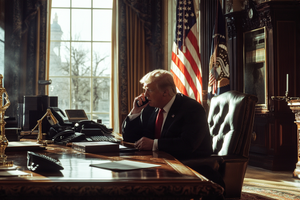
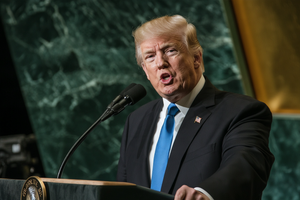
In freight logistics, the annual shipper summit is the day when every open contract, every unresolved rate dispute, and every strategic realignment gets compressed into a single agenda. Every bilateral meeting is a negotiation. Every speech from the podium signals what the carrier is actually prepared to do versus what it said last quarter. Today is the freight summit for the United States government. President Trump is addressing the United Nations General Assembly and conducting 11 bilateral meetings in a single day — a schedule that the White House confirmed to AP covers everything from the Iran nuclear file to Greenland to Gaza to Venezuela. The agenda tells you exactly where the administration sees its most urgent unresolved freight: the meetings are with the people Trump needs to either deliver something or extract something from before November 4.
U.S. Ambassador to the UN Mike Waltz told reporters that Trump's speech will cover four themes: peace deals, U.S. actions in the Western Hemisphere, a plan for Gaza, and preventing Iran from obtaining a nuclear bomb. Those four themes are not random — they are the four open freight lanes where the administration either has progress to announce or pressure to apply. On Iran specifically, Trump said separately over the weekend that he believes Tehran will stall on any deal until after the midterm elections in order to damage him politically. That framing — Iran as a midterm actor, not just a geopolitical adversary — changes the calculus on when and whether a deal is reachable before November 4.
For the pre-retiree watching from a 401(k), a bond allocation, or a HELOC statement that just went up, today's UNGA schedule is the most concentrated single-day geopolitical event since the conflict began 205 days ago. The meetings with Gulf leaders determine whether the oil blockade continues or shifts. The bilateral with Zelensky signals whether the Ukraine file can be closed to free up diplomatic bandwidth for Iran. The Greenland and Denmark meetings are territorial positioning ahead of what the administration has described as a hemisphere-consolidation strategy. Every one of these conversations lands on a day when oil is at $107.80, the 10-year Treasury is above 5%, and the Fed has just signaled one more hike in December. The freight is all moving at once.
Sponsored
If you're near or over 73, this matters.
Most retirees take their Required Minimum Distributions (RMDs) the default way.
In cash.
And that's where the problem starts.
Because taking RMDs the wrong way can mean:
• More taxes for Washington
• Less compounding for you
• A smaller legacy for your family
What most retirees don't realize is that IRS Code 408(m) allows RMDs to be handled differently — in a way that may help protect more of what you've earned.
But timing matters.
Once the distribution hits your account, options shrink fast.
We created a free guide explaining:
• The #1 RMD trap
• Why inflation quietly erodes cash distributions
• How some retirees are repositioning before it's too late
Download your FREE RMD Guide here.
Because the most expensive mistake…
Is waiting until after the check clears.
Allegiance Gold, LLC is not a broker-dealer and does not provide investment, tax, or legal advisory services. No statement in this communication should be construed as a recommendation to purchase or sell any security, or as investment, tax, or legal advice. Precious metals, like all investments, carry risk, are not suitable for all investors, and past performance does not guarantee future results. We do not guarantee any investment performance. Please consult your own investment, tax, or legal advisor prior to making any investment decision. Third-party information quoted or presented by us in this communication represents only the opinions of the third party and we do not endorse any third-party source of information. We are not affiliated with the U.S. Mint or any government agency. Copyright Allegiance Gold, LLC 2026
The Inefficiency Leak — Deconstructing the 11-Meeting Day
Today's UNGA Schedule — Confirmed by White House and AP
UNGA Address — General Assembly Hall
Per Waltz: peace deals, Western Hemisphere actions, Gaza plan, preventing Iranian nuclear bomb. Speech content unconfirmed at time of publication.
Volodymyr Zelensky — Ukraine
First bilateral since the Iran conflict escalation. The Ukraine file's resolution — or continued stall — directly affects how much diplomatic bandwidth the U.S. has for the Iran track.
Andy Burnham — Mayor of Greater Manchester, UK
Sub-national bilateral — unusual at UNGA level. Signals U.S. interest in direct city/region relationships independent of central government, consistent with the administration's Western Hemisphere consolidation framework.
Delcy Rodríguez — Venezuela
Venezuela's VP and foreign minister. The administration's Venezuela file is intertwined with oil supply: Venezuela holds the Orinoco Belt, the subject of the 55% control deal announced earlier this year. This meeting is oil and hemisphere policy simultaneously.
Prime Ministers of Denmark and Greenland
Greenland territorial positioning. The administration has made clear it views Greenland as a strategic asset in the Arctic competition with Russia and China. These bilateral meetings are part of the ongoing pressure campaign.
Gulf State Leaders — Saudi Arabia, UAE, Qatar, Bahrain, Kuwait, Oman
The most consequential meetings of the day. Gulf leaders hold veto power over resumed Iran operations — as demonstrated in August. Their position on the Iran file determines whether "decision mode" resolves before or after November 4.
"Iran Will Stall Until the Midterms to Hurt Me" — What This Framing Changes
Trump said over the weekend that he believes Iran will stall on any deal until after the November 4 midterms in order to damage him politically. This framing is significant for two reasons. First, it sets up a post-midterm escalation narrative: if Iran has not made a deal by November 4, Trump has already told the public that Iran was playing politics — which gives him domestic justification to escalate after the election regardless of what the military or diplomatic situation looks like. Second, it complicates today's UNGA diplomacy: if Trump publicly believes Iran is stalling for political reasons, any Iranian gesture at UNGA — however substantive — will be viewed through the lens of whether it is genuine or a tactical move to appear cooperative without conceding anything material. The "stalling to hurt me" framing transforms a potential diplomatic opening into a credibility test that Iran almost cannot pass before November 4.
The Gulf Meetings — Why These Are the Most Consequential Bilaterals of the Day
Saudi Arabia, UAE, Qatar, Bahrain, Kuwait, and Oman are not passive observers of the Iran conflict. They are the parties that stopped the last escalation: in early August, Saudi Arabia and Qatar told Trump that resumed major combat operations would trigger Iranian retaliation against their oil facilities, and Trump paused the operations. Today's Gulf meetings are the follow-up to that conversation. What the Gulf leaders tell Trump today about their current risk tolerance — whether they are now willing to absorb Iranian retaliation, or whether they still oppose escalation — is the actual determinant of whether the "decision mode" Trump described Saturday resolves as military action or continued blockade. The diplomatic readouts from these meetings will be vague. Watch what happens to oil in the 24 hours after they conclude.
The Zelensky Meeting — Ukraine as a Variable in the Iran Equation
Trump's bilateral with Zelensky today comes 205 days into the Iran conflict, at a moment when the administration is managing two active theaters simultaneously — neither of which has been resolved. Ukraine and Iran are not unrelated: Russia has been the primary supplier of ballistic missile components to Iran, and Iran has been supplying drones to Russia. Any deal with Iran that includes cessation of missile technology transfer to Russia changes the Ukraine military equation. Any Ukraine settlement that requires Russian concessions on Iran creates a trilateral diplomatic problem. Trump's administration has consistently treated Ukraine and Iran as separate tracks — but the bilateral today happens in a week when both tracks are simultaneously at decision points.
Waltz's Four Speech Themes — What "Preventing Iran's Nuclear Bomb" Signals at UNGA
Mike Waltz told reporters Trump's UNGA address will include "preventing Iran from obtaining a nuclear bomb." The framing is significant: the current conflict began as a military operation targeting Iran's nuclear infrastructure, missile program, and ballistic capability. Waltz framing the speech around nuclear prevention — rather than around war termination or sanctions — signals that the administration's public posture at UNGA is that the Iran file is a non-proliferation problem, not a conflict termination problem. That framing justifies continued military pressure (to prevent nuclear acquisition) even while leaving diplomatic space open (to prevent the bomb through a deal). It is the framing that allows Trump to say "decision mode" and "probably open to meeting Pezeshkian" in the same week without contradiction.
Fact-Check Conclusion:
Trump addressing UNGA today, September 22: confirmed White House and AP. 11 bilateral meetings scheduled: confirmed AP. Meetings with Burnham, Zelensky, Delcy Rodríguez, Danish PM, Greenland PM, Gulf state leaders: confirmed White House schedule per AP. Waltz speech preview — peace deals, Western Hemisphere, Gaza, preventing Iranian nuclear bomb: confirmed AP reporting. Trump statement that Iran will stall until midterms to hurt him: confirmed separate reporting cited in briefing. Speech content at time of publication not yet delivered: confirmed — this article published before address. Brent crude $107.80: confirmed market data. Days to midterms (43): confirmed from November 4 electoral date. Days since conflict began (205): confirmed from February 28 start date.
The Arbitrage Alert — What to Watch From Today's UNGA
Watch the Oil Market Response to Gulf Meeting Readouts:
The diplomatic readouts from Trump's Gulf state meetings will be released today or tomorrow in carefully worded press statements. The actual content will be vague. The oil market is the honest interpreter: if Brent moves above $112 in the 24 hours after the Gulf readouts, the market is reading that the Gulf states gave Trump greenlight for escalation. If Brent falls below $103, the market is reading that the Gulf states pushed for continued blockade or diplomacy. The current $107.80 is the uncertainty price. A directional break after today's meetings is the real signal.
Whether a Trump-Pezeshkian Meeting Is Confirmed Today:
Trump said Saturday he is "probably open" to meeting Iranian President Pezeshkian at UNGA. If that meeting is announced or confirmed today, the diplomatic track becomes the dominant narrative and oil pulls back. If it is not confirmed by end of day, the "stalling to hurt me" framing takes over, and the post-midterm escalation scenario becomes the market's primary pricing scenario. Watch for confirmation or denial of the Pezeshkian bilateral by end of business today.
The Venezuela Meeting and Your Energy Allocation:
Trump's bilateral with Delcy Rodríguez continues the Orinoco Belt deal track — the administration's effort to bring Venezuelan heavy crude into the U.S. supply chain as a partial offset to lost Iranian and Hormuz-disrupted volumes. If the Venezuela track advances, it adds marginal downward pressure on oil by signaling alternative supply. If it stalls, it reinforces that Iranian supply disruption has no near-term replacement. Either outcome is visible in Brent's direction after the meeting readout.
The BS-Meter — Headlines vs. The Fine Print
The Headline
"Trump's UNGA Speech Will Solve the Iran Crisis"
The Fine Print
Speeches at UNGA do not solve crises. They signal positions, apply pressure, and create diplomatic record. The Iran file will not be resolved by a speech to the General Assembly. It will be resolved — or not — by the bilateral meetings that happen on the sidelines, specifically with the Gulf states whose veto power over U.S. military action has been established since August. Watch the bilaterals, not the podium address.
The Headline
"Iran Is Stalling — Trump Should Strike Now Before the Election"
The Fine Print
Trump said he believes Iran is stalling for political reasons — that is his assessment of Iranian intent, not a verified fact. Iran has not publicly stated it is stalling to damage Trump politically. What Iran has done is maintain a negotiating posture while not conceding on the nuclear file. Whether that constitutes "stalling" or "holding firm on core interests" depends on whose framing you accept. Brent at $107.80 is the market's honest assessment — uncertainty, not imminent escalation.
The Headline
"11 Meetings in One Day Means Trump Is Close to Closing Multiple Deals"
The Fine Print
UNGA bilateral meetings are typically 20–40 minutes each. 11 meetings in one day is a packed schedule — it does not indicate deals are close. It indicates the administration is maintaining diplomatic contact across multiple open files simultaneously. The freight industry equivalent is a shipper calling 11 carriers in one day: it means a decision is being approached, not that contracts are about to be signed.
The Backhaul Index: UNGA Day Snapshot
🌐 Bilateral Meetings Today
11 Confirmed White House/AP · Most consequential: Gulf state leaders
The Gulf meetings determine the Iran military track. The Zelensky meeting signals diplomatic bandwidth. The Venezuela meeting signals the oil supply alternative track. All three outcomes matter for Brent's direction tomorrow.
🛢️ Brent Crude — The Honest Interpreter
$107.80 Uncertainty price — watch for directional break after Gulf readouts
Above $112 = market reads Gulf greenlight for escalation. Below $103 = market reads continued blockade or diplomacy. Current $107.80 is maximum uncertainty pricing.
☢️ Nuclear Framing in Speech
"Prevent the Bomb" Per Waltz briefing · Non-proliferation not war termination framing
Framing Iran as a nuclear prevention problem — not a conflict termination problem — justifies continued military pressure while keeping diplomatic space open. Both "decision mode" and "probably open to meeting" are consistent with this framing.
🗳️ Iran Stall Claim + Midterm Calendar
43 days To November 4 · Trump says Iran deliberately stalling
If Iran has not made a deal by November 4, Trump has pre-established the political narrative (Iran stalled deliberately) that justifies post-midterm escalation. Today's UNGA is the last major diplomatic window before that 43-day clock runs out.
The Wire: What Happens After Today
The 43-Day Window — What Has to Happen Before November 4 for the Iran Track to Close
For the Iran war to resolve before the midterms, three things have to happen in sequence within 43 days: Iran has to signal genuine flexibility on the nuclear file (not tactical delay), the Gulf states have to confirm they can absorb any Iranian retaliation against their oil infrastructure, and Trump has to accept a deal framework that is politically sellable to his base as a "win" rather than a capitulation. All three conditions have to be met simultaneously. Trump's "stalling to hurt me" framing makes condition one significantly harder to meet — any Iranian flexibility before November 4 will be read by Trump's team as a tactical move rather than genuine concession. The most likely scenario, based on today's signals, is that the UNGA week produces diplomatic engagement without resolution — and the real decision comes after November 4, when the electoral constraint is removed.
In freight, when both parties in a rate dispute agree to "continue discussions" after a summit, experienced auditors know what that means: the dispute is not resolved, neither party has moved off their position, and the next negotiation will happen after whatever external event was constraining both sides has passed. In this case, that external event is November 4. "Continue discussions" is the most likely UNGA outcome on Iran. The oil market already knows this. That is why Brent is at $107 and not at $85.
AC
Art Callahan · Ex-logistics auditor, The Backhaul Report
Gaza, Greenland, Western Hemisphere — The Three Files That Frame Trump's "Peace Deals" Theme
Waltz's preview of Trump's speech included "peace deals" and "U.S. actions in the Western Hemisphere" as two of the four themes. Taken together, these signal that the administration is framing UNGA as the venue where it demonstrates momentum on multiple resolution tracks simultaneously — Gaza, Greenland, Venezuela, Ukraine — to build the narrative that Trump is a deal-closer, not a war-escalator. This is midterm messaging embedded in a diplomatic schedule. The substance of the Gaza plan, the Greenland negotiation status, and the Venezuela oil deal will all be part of the speech and bilateral readouts. Each one matters independently — and each one is also a data point in the domestic political argument that the Trump foreign policy is producing results, even as the Iran file remains unresolved at $107 oil.
The speech themes Waltz previewed — peace deals, Western Hemisphere, Gaza, nuclear prevention — are not a foreign policy agenda. They are a midterm election agenda dressed in diplomatic language. That is not a criticism. Every president uses UNGA as a platform for domestic messaging. The honest pre-retiree investor reads it as: the administration's external posture is "we are closing things," but the oil market's internal read is "nothing is closed yet." Both can be true simultaneously. One of them affects your HELOC payment. The other affects your vote.
AC
Art Callahan · Ex-logistics auditor, The Backhaul Report