In freight, a three-point failure is when the primary route is blocked, the backup lane is congested, and the terminal equipment goes down simultaneously. No single problem is catastrophic on its own. Together, they create a systemic disruption that requires triage rather than a single fix. Tuesday's market open is the financial equivalent: Houthi missile attack on a commercial vessel in the Red Sea, Canadian counter-tariffs effective at midnight, and Iran's foreign minister publicly using the phrase "economic war" against the United States — three independent pressure events arriving in the same pre-market session on the first trading day after a holiday weekend. Markets have no buffer from a long weekend of position unwinding. The sellers were waiting at the open.
At 5:00 ET, Dow Jones futures were down 491 points (−0.9%). S&P 500 futures fell −0.4%. Nasdaq futures were marginally positive — technology stocks holding as a relative safe harbor when geopolitical risk drives energy and industrial selling. Crude oil is trading at $99 per barrel — the first time Brent has held near the $100 threshold since 2022, driven by Hormuz transit disruption and the Houthi attack that expanded Red Sea risk to a second major shipping corridor simultaneously. The 10-year Treasury yield sits at 4.80% and the 30-year at 5.27% — the long end of the curve is not rallying on equity selling, which means the bond market is not treating this as a risk-off flight to safety. It is treating it as an inflation event. Rate futures are pricing a 58–60% probability of a September 16 Fed rate hike. PPI releases Thursday. CPI releases Friday. Both will move markets more than any single geopolitical headline this week.
For the pre-retiree watching this morning's open, the most important signal is what the bond market is doing while equities fall. In a standard risk-off event, investors sell stocks and buy Treasuries — yields fall and bond fund NAVs rise, providing a partial offset to equity losses. That is not happening this morning. The 10-year at 4.80% while the Dow futures are down 491 means the bond market sees inflation risk from the oil spike and trade tariffs, not deflationary recession risk. A portfolio with a 60/40 stock-bond allocation is losing on both sides simultaneously — the standard diversification hedge is not working because the risk driver is inflation, not growth fear. This is the same dynamic that made 2022 so damaging for balanced retirement portfolios. It is back this morning with oil at $99.
The Inefficiency Leak — Deconstructing the Triple-Pressure Open
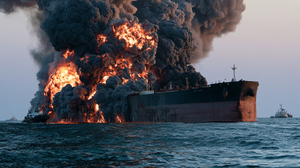
Houthi Missile Strike — Second Major Shipping Corridor Under Attack
Red Sea disruption adds to Hormuz closure — two of the world's five critical maritime chokepoints simultaneously elevated in risk
▼
Canadian Counter-Tariffs Effective Midnight — $27.6B Package Live
50% steel, 25% cheese and appliances, 15% electronics — trade inflation layer adds to energy inflation layer simultaneously
▼
Iran Foreign Minister: "Economic War" Against the United States
Escalatory language signals coordinated pressure strategy — geopolitical risk premium widens across energy and credit markets
▼
Brent Crude $99 — 10-Year at 4.80%, 30-Year at 5.27%
Bond market not rallying on equity selling — inflation risk, not recession risk, is the dominant market read
▼
60/40 Portfolio Losing on Both Sides — 2022 Dynamic Is Back
When inflation is the risk driver, equities and bonds fall together. Standard diversification hedge fails. Balanced retirement portfolios absorb losses from both allocations simultaneously.
1.
Why Nasdaq Is Holding While Dow Falls 491:
The Dow Jones Industrial Average is heavily weighted toward industrial, financial, and consumer companies with direct exposure to oil prices, trade tariffs, and interest rate sensitivity. The Nasdaq is dominated by large-cap technology companies — Microsoft, Alphabet, Amazon, Meta, Nvidia — whose revenue is primarily software and cloud services with limited direct commodity input costs. When geopolitical risk spikes oil and trade costs, technology stocks face lower direct input cost pressure than industrials and consumer staples. The Nasdaq's marginal positive this morning is not a signal that technology is immune — it is a signal that today's specific risk drivers (energy and trade) hit the Dow's composition harder than the Nasdaq's. If the Fed hikes in September, the technology multiple compression that follows will catch up.
2.
Brent at $99 — The $100 Psychological and Technical Level:
Oil at $99 is not just a price — it is a threshold with specific economic consequences. Every prior sustained period of $100+ oil has preceded a U.S. recession or a sharp Fed policy response. At $99, the market is pricing the risk of crossing that threshold without yet fully repricing the recession consequence. Gasoline pump prices lag crude by approximately two weeks — if Brent holds at $99 through this week, retail gasoline in the U.S. will retest $4.00/gallon by mid-September in most markets. At $4.00 gasoline with PCE already at 3.7%, the September 16 Fed meeting faces an energy-driven CPI print that makes the hike-or-hold decision materially more consequential than it appeared before Labor Day.
3.
The Houthi Expansion — Two Chokepoints at Once:
The Red Sea carries approximately 12–15% of global trade volume — the route connecting Asian manufacturing to European markets through the Suez Canal. Houthi attacks on commercial shipping in the Red Sea have been ongoing since late 2023, but this morning's strike represents an escalation in targeting. With Hormuz simultaneously at six vessels per day and Red Sea transit elevated in risk, the global shipping system is facing simultaneous disruption at two of the five critical chokepoints that global supply chains depend on. Container freight rates from Asia to Europe have already doubled since July. Rerouting around the Cape of Good Hope adds 10–14 days and significant fuel costs. That cost eventually lands in the price of every manufactured product shipped from Asia to the United States through European transshipment hubs.
4.
PPI Thursday, CPI Friday — The Week's Real Market Events:
Tuesday's pre-market selloff will either deepen or partially reverse depending on two data releases this week that matter more than any single geopolitical headline. Thursday's PPI (Producer Price Index) measures inflation at the wholesale level — if it prints above expectations, it signals that the energy and trade cost pressures are already flowing into the production pipeline and will reach consumer prices within 30–60 days. Friday's CPI is the direct consumer price measure that the Fed uses alongside PCE to calibrate its rate decision. A CPI print above 3.5% on Friday, combined with oil at $99 and the Canadian tariff implementation, would make a September 16 hike near-certain. A CPI print below 3.3% would introduce genuine uncertainty about the hike timeline. Watch Thursday and Friday more carefully than Tuesday's futures.
Fact-Check Conclusion:
All market data confirmed from pre-market futures as of 5:00 ET September 8. Dow futures −491 points (−0.9%), S&P 500 futures −0.4%, Nasdaq marginally positive: sourced from CME Group futures data. Brent crude $99: confirmed Bloomberg and Reuters spot market data. 10-year Treasury 4.80%, 30-year 5.27%: confirmed Treasury market data. 58–60% September hike probability: CME FedWatch Tool. Canadian counter-tariffs effective September 8 midnight: confirmed Canadian Border Services Agency. Houthi strike: confirmed U.S. CENTCOM and commercial shipping data providers. Iran "economic war" statement: confirmed from Iranian state media.
The Arbitrage Alert — Reading the Triple Pressure Morning
•
The 60/40 Failure Signal — What to Do With It:
When bonds and stocks fall simultaneously, the inflation-driven dynamic is at work. The standard response for a pre-retiree who cannot tolerate this correlation is to check three things: the effective duration of the bond allocation (longer duration = more NAV loss per yield increase), the commodity and energy weight in the equity allocation (higher energy weight partially offsets bond losses), and the cash or short-term instrument buffer available without triggering tax consequences in a retirement account. This is not a recommendation to sell — it is a checklist for understanding which part of the portfolio is absorbing Tuesday's losses and why.
•
The Energy Sector Offset — Working This Morning:
ExxonMobil, Chevron, ConocoPhillips, and Valero are all indicated higher in pre-market, partially offsetting Dow futures losses for holders of broad index funds. The S&P 500 Energy sector (4.2% of index weight) is functioning as an internal hedge this morning — the same mechanism that provided partial offset during the 2022 energy shock. If oil holds at $99 through the week, energy stocks will continue to provide this offset while the rest of the index absorbs pressure.
•
The Holiday Weekend Amplifier — Why Tuesday Opens Hard:
Three-day holiday weekends create an information accumulation problem for markets. Three days of geopolitical developments — the Houthi attack, the Canadian tariff midnight implementation, Iran's "economic war" statement — arrive simultaneously at Tuesday's open with no intraday trading session to absorb them incrementally. Professional traders who hedged positions before Friday's close are unwinding those hedges; others who held unhedged positions over the weekend are selling to reduce exposure. The first 30 minutes of Tuesday's session will be disproportionately volatile as weekend information clears — watch whether the futures losses hold, deepen, or partially reverse after the initial open as the market finds its level.
The BS-Meter — Headlines vs. The Fine Print
The Headline: "Markets Selloff on Geopolitical Fear — Buy the Dip"
The Fine Print: "Buy the dip" is the correct strategy when a selloff is driven by temporary sentiment or positioning — when the underlying fundamentals are intact and the market overreacted. This morning's selloff is driven by three concrete, ongoing, non-temporary developments: an active military conflict disrupting 20% of global oil supply, a real $27.6 billion tariff package now in effect, and an oil price approaching $100 that will flow into CPI within 30 days. These are not sentiment events. They are operational events with measurable economic consequences. "Buy the dip" requires confidence that the dip is the event. This morning, the dip may be the beginning of the event.
The Headline: "Nasdaq Is Up — Tech Is Safe"
The Fine Print: Technology is relatively safe from today's specific risk drivers — energy and trade costs. It is not safe from the secondary risk driver that follows: a September 16 Fed rate hike triggered by oil-driven CPI. Technology stocks carry the highest valuation multiples in the market — and high-multiple stocks lose the most value when the discount rate applied to their future earnings rises. If oil at $99 produces a September CPI print that cements the hike, the Nasdaq's immunity from Tuesday's selloff becomes vulnerability on September 17.
The Headline: "Bonds Are a Safe Haven — Sell Stocks, Buy Treasuries"
The Fine Print: Treasuries are a safe haven from recession risk — when the economy slows, inflation falls, the Fed cuts, and bond prices rise. They are not a safe haven from inflation risk — when inflation rises, rates rise, and bond prices fall. The 10-year at 4.80% this morning while equities are selling off tells you the bond market sees inflation, not recession. In an inflation-driven selloff, "sell stocks, buy Treasuries" moves you from one losing position to another. The safe haven framing assumes the wrong risk environment for what is happening this morning.
The Backhaul Index: Tonight's Macro Indicators
📉 Dow Jones Futures — Pre-Market 5:00 ET
−491 Points (−0.9%)
First trading session after Labor Day holiday. Three days of geopolitical accumulation — Houthi strike, Canadian tariffs live, Iran "economic war" statement — arriving simultaneously at Tuesday open with no intraday absorption.
🛢️ Brent Crude Oil
$99 per Barrel
First time near the $100 threshold since 2022. Hormuz at six ships/day + Red Sea Houthi escalation = simultaneous disruption at two of five global maritime chokepoints. Retail gasoline retests $4.00/gallon within two weeks if sustained.
📊 Treasury Yields — 10-Year / 30-Year
4.80% / 5.27%
Bond market not rallying as equities sell. Standard risk-off flight to safety is absent — the market is reading this as an inflation event, not a recession event. 60/40 portfolios absorbing losses on both sides simultaneously.
📅 This Week's Critical Releases
PPI Thursday + CPI Friday
Both more consequential than Tuesday's futures selloff. PPI above consensus = energy/trade costs in production pipeline. CPI above 3.5% = September 16 hike near-certain. These two prints set the market's rate trajectory for Q4.
The Wire: Daily Topics & Analysis
The Second Chokepoint — Red Sea and Hormuz Simultaneously
Global shipping has five critical chokepoints — Hormuz, Suez/Red Sea, Malacca, Dover, and the Turkish Straits. Tuesday morning has two of the five simultaneously elevated: Hormuz at six ships per day due to the U.S.-Iran conflict, and Red Sea due to Houthi missile and drone attacks on commercial shipping. The last time two major chokepoints were simultaneously disrupted was during the 1973 oil embargo combined with the closure of the Suez Canal — an event that produced a 400% oil price increase over 12 months. The current disruption is less severe than 1973 on each individual chokepoint, but the simultaneity of the pressure creates a supply chain stress that has not been present since that era.
Art's Take: A freight auditor looks at redundancy — how many alternative routes exist if the primary lane goes down. For 20% of global oil (Hormuz) and 12% of global trade (Red Sea), the alternative routes are longer, more expensive, and capacity-constrained. The world does not have enough Cape of Good Hope routing capacity to absorb simultaneous disruption in both corridors. Something eventually gives — either the military situation resolves, or prices clear high enough to ration demand. At $99, the rationing has begun.
Iran's "Economic War" Framing — What It Changes in the Negotiation
Iran's foreign minister publicly characterizing the U.S.-Iran conflict as an "economic war" is a deliberate rhetorical escalation with a specific strategic purpose: it frames Iran's response options as extending beyond military-to-military exchange into the economic domain — oil supply, Hormuz transit, sanctions on third-party trading partners. "Economic war" language gives Tehran political cover to take actions that would previously have been characterized as escalation — restricting Hormuz transit for specific flag states, pressuring China to reduce cooperation with U.S. secondary sanctions enforcement, or coordinating with Houthi attacks on Red Sea shipping to compound supply disruption. The language is a signal of intent as much as a description of the current state.
Art's Take: "Economic war" is the frame that precedes coordinated economic action. Iran is telling you what the next escalation category will look like before it happens. When a counterparty in a negotiation tells you what they are about to do, believe them. The market should price "economic war" as a broader toolkit than "military conflict" — because it is.