In the freight business, there is a principle called rate independence: the carrier sets the price based on fuel costs, capacity, and demand — not based on what the shipper wants to pay. The moment a carrier starts pricing based on shipper preference rather than operational reality, the business model breaks. Trump understood this principle well enough to install Kevin Warsh at the Federal Reserve in May with a public promise of "total independence." What Trump may not have fully modeled is the operational reality that independent means independent — including independent of the man who appointed you. Forty-eight hours from now, on Wednesday, Warsh will deliver the most politically charged rate decision of the year. The market is pricing an 86% probability he hikes. Trump has spent the last two weeks publicly demanding he doesn't.
The setup entering this week: Brent crude at $107.80, the 10-year Treasury at 4.98%, core CPI running hotter than expected in August, and the August jobs report that added 162,000 positions — nearly triple the 55,000 consensus. Those four data points, taken together, built the case that Warsh laid out at Jackson Hole: strong labor market at elevated inflation equals tightening. Markets responded accordingly. CME FedWatch now shows 86% probability of a 25-basis-point hike on September 16. Trump's response: he escalated. In the past ten days, the president, vice president, Treasury Secretary Bessent, and senior economic adviser have all publicly urged the Fed not to hike — an unusually broad pressure campaign even by the standards of Trump's long history with central bank criticism. Trump himself, when asked Sunday, said Warsh would "do what he has to do" — a partial retreat from the full-court press, but not a retraction.
For the pre-retiree holding a 60/40 portfolio, a mortgage, or a bond fund inside a 401(k), the Wednesday outcome is not abstract. A confirmed 25-basis-point hike adds approximately $16–$20 per month to a variable-rate HELOC on a $300,000 balance. It adds 0.7–1.0% NAV pressure to a bond fund with 7-year duration. It prices the next six months of rate risk into every fixed-income instrument you hold. And it sets the political stage for the midterms: a Fed that hikes against explicit presidential pressure two months before November 4 becomes the story that either vindicates institutional independence or demonstrates its fragility, depending on which direction the economy moves afterward.
Sponsored
Bank of America revealed your expiration date.
In their Bloomberg interview, they said the digital dollar was inevitable.
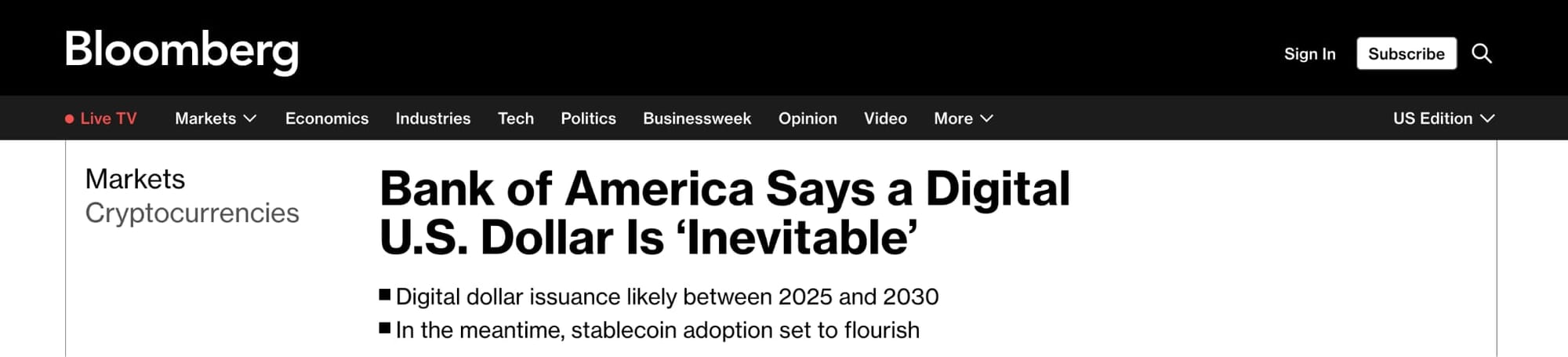
Their exact words: CBDCs are an "inevitable evolution of today's electronic currencies."
The Federal Reserve has already asked for public comment. The infrastructure is being built as you read this.
Once the digital dollar launches, every transaction you make can be tracked. Your spending could be controlled. Your accounts could be frozen.
China already did this. Nigeria already did this.
But there's still a way to preserve your privacy.
I'm Tan Gera, ex-Wall Street banker and CFA© Charterholder.
I left the system when I saw what was coming.
Over 4,500 investors have already used this method to hold assets the government can't freeze and generate yields the Federal Reserve can't touch.
Watch how to access this escape hatch before it closes →
The window is closing.
To your freedom,
Tan Gera, CFA©
Decentralized Masters
P.S. Bank of America called the digital dollar "inevitable." Discover the easy method investors are using to escape →
The Inefficiency Leak — Deconstructing the Warsh-Trump Standoff
February 2026: Trump Nominates Warsh — "He Would Not Have Gotten the Job If He Wanted Rate Hikes"
Trump publicly signals his expectation: Warsh is a rate-friendly choice. Warsh says nothing to contradict this publicly.
▼
May 22: Sworn In — Trump Urges "Total Independence"
Handshakes, warm words. Trump praises his choice and tells reporters the Fed will be completely independent under Warsh.
▼
August 28: Jackson Hole — Warsh Signals Inflation Is Not Beaten
"Not constrained by market prices." Financial conditions not restrictive. Three FOMC members already want a hike. Markets begin pricing September action.
▼
Sept. 5–13: Trump Full-Court Press — President, VP, Bessent, Senior Adviser All Urge No Hike
Unprecedented breadth of public pressure. Trump simultaneously denies talking to Warsh repeatedly while WSJ reports he has. Markets raise hike probability anyway.
▼
Sept. 16, 2:00 PM ET: Decision — 86% Market Probability of 25bps Hike
Warsh either hikes and tests Fed independence under direct presidential pressure — or holds and raises questions about whether that independence still exists.
1.
Why Warsh Is Almost Certainly Hiking Anyway:
Warsh's entire intellectual and professional identity is built on the argument that the Fed must maintain credibility by following the data, not political pressure. He wrote about this before he was chair. He testified about it. He built his Jackson Hole speech around it. A man who spent years arguing that the Fed's credibility is its most valuable asset cannot, in his first major decision under direct presidential pressure, capitulate to that pressure without destroying the institutional credibility he was brought in to restore. The market's 86% hike probability is not just a data read — it is a character read. The market believes Warsh is who he says he is. If he holds, he is not who he said he was, and the bond market will price that uncertainty for months.
2.
What Trump Actually Wants — and Why He Said "Do What He Has To Do":
Trump's Sunday partial retreat — "Warsh will do what he has to do" — is not a concession. It is a classic Trump positioning move: apply maximum public pressure, then create distance before the decision so the outcome does not look like a public loss. If Warsh hikes, Trump's framing will be that he disagreed but respected institutional independence. If Warsh holds, Trump takes full credit. The pressure campaign was designed to achieve a hold if possible and to preserve a narrative regardless of outcome. What makes this week different from Trump's Powell-era Fed criticism is that Warsh is Trump's own nominee — meaning a hike does not just test Fed independence, it tests Trump's judgment in who he appointed.
3.
The Data Case for Hiking — It Is Not Close:
August jobs: +162,000, nearly triple the 55,000 consensus. Unemployment: 4.1%, unchanged. Core CPI August: hotter than expected. Brent: $107.80 — loading October's CPI with 0.65–0.70 percentage points of additional energy inflation. 10-year Treasury: 4.98%, approaching 5% for the first time since the pre-conflict era. PCE: 3.7% for six consecutive quarters. The data does not build a hold case. It builds a case that the Fed is behind the curve. Warsh's own Jackson Hole language — financial conditions "not restrictive" — was a forward signal that the current rate level is insufficient for the inflation environment. The only argument for holding is political, not economic.
4.
The Midterm Dimension — Why November 4 Is Already in the Room on Wednesday:
Every FOMC member in the room on Wednesday knows that a 25-basis-point hike, implemented 49 days before midterm elections, adds to the financial pressure on American households that are already absorbing $107 oil, Canadian counter-tariffs, and 3.4%-and-rising inflation. They also know that failing to hike when the data clearly demands it — because of political proximity to an election — is the kind of Fed behavior that destroys credibility for a decade. The Fed's dual mandate does not include "do not raise rates near elections." Every time the Fed has appeared to time its decisions around electoral calendars, the long-term cost to its institutional credibility has been severe. Warsh knows this better than anyone in that room.
September 16 Rate Hike Probability — CME FedWatch
Source: CME FedWatch Tool. NFP +162K on Sep 8 and hot core CPI on Sep 11 drove the acceleration.
Fact-Check Conclusion:
86% September 16 hike probability: confirmed CME FedWatch as of September 14 morning. Warsh sworn in May 22: confirmed. Trump "would not have gotten the job if he wanted rate hikes" quote: confirmed Seeking Alpha / February 2026 record. Trump's "do what he has to do" Sunday comment: confirmed PBS NewsHour. Trump, VP, Bessent, senior adviser all publicly urged no hike in past 10 days: confirmed CNBC, Bloomberg, Federal News Network. August NFP +162,000 vs. +55,000 consensus: confirmed BLS. Core CPI hotter than expected August: confirmed BLS release September 11. Brent $107.80: confirmed IC Trading / September 14 morning data. 10-year Treasury 4.98%: confirmed IC Trading data.
The Arbitrage Alert — Wednesday's Decision and Your Portfolio
•
If Warsh Hikes — The Confirmed Scenario (86% Priced):
The 25bps hike is already 86% priced — meaning the bond market has already absorbed most of the move. The incremental selloff on a confirmed hike is smaller than if probability were at 50%. What markets will focus on Wednesday is not the hike itself but Warsh's press conference language: does he signal another hike is coming in November, or does he frame Wednesday as a one-and-done response to the current data? "One more and done" is bond-bullish. "More hikes may be needed" is bond-bearish. The press conference at 2:30 PM ET matters more than the 2:00 PM decision.
•
If Warsh Holds — The Surprise Scenario (14% Priced):
A hold against 86% market pricing produces an immediate and significant bond rally — the 14% of unpriced hold probability unwinds in minutes. 10-year yields could fall 15–20bps on the announcement. Bond fund NAVs spike 1.0–1.4% in the session. Equity markets rally sharply on rate relief. But the second-order question becomes immediate: did Warsh hold because of the data, or because of Trump? If it is perceived as the latter, the Fed's inflation-fighting credibility takes a serious hit — and long-term yields eventually rise to compensate for the credibility loss, erasing the initial bond rally. A hold that looks like a capitulation is not good for long-term bondholders even if it is good for them on Wednesday afternoon.
•
Your HELOC and Variable-Rate Debt — The Direct Line:
Home equity lines of credit, adjustable-rate mortgages, and most variable-rate consumer debt reprice directly off the Federal Funds rate with a 30-day lag. A confirmed 25bps hike on Wednesday means your October HELOC statement is $16–$20 higher per $100,000 of outstanding balance. On a $300,000 HELOC, that is $48–$60 per month — added to the increases from prior hike cycles that have compounded over the past three years. This is not a one-time event. It is an incremental addition to a rate burden that has been building since 2023.
The BS-Meter — Headlines vs. The Fine Print
The Headline: "Trump Is Bullying the Fed — This Is an Attack on Independence"
The Fine Print: Every president since Nixon has expressed preferences about Fed policy. Trump expressing a preference — even loudly — is not the same as institutional capture. Independence is demonstrated by the decision, not by the absence of presidential commentary. If Warsh hikes on Wednesday, the institutional independence argument is confirmed in the only place it matters: the outcome. Presidential pressure that produces no policy deviation is pressure, not capture.
The Headline: "A Rate Hike Now Would Cause a Recession — Trump Is Right"
The Fine Print: The economy added 162,000 jobs in August on a consensus of 55,000. Unemployment is 4.1%. Core CPI is running hot. These are not the conditions that precede a rate-hike-triggered recession — they are the conditions under which the Fed's mandate requires tightening. A recession caused by a 25bps hike in an economy generating 162,000 jobs per month at 4.1% unemployment would be the weakest economy in modern history. The recession risk from a hike is real but not the primary risk. The inflation entrenchment risk from holding is higher.
The Headline: "86% Probability Means Hike Is Certain — Just Wait for Wednesday"
The Fine Print: 86% is not 100%. The 14% hold scenario is a real tail risk that produces outsized market moves because it is so under-priced. The bond rally on a surprise hold would be sharper than the bond selloff on a confirmed hike, precisely because the hike is already priced. The asymmetry of Wednesday's risk is: small downside from a confirmed hike (already 86% in the price), large upside from a surprise hold (only 14% priced). For bond holders, the expected value of Wednesday is modestly negative — but the surprise scenario is materially positive.
The Backhaul Index: Monday Morning Macro
🏦 September 16 Hike Probability
86% — CME FedWatch
Up from 49% on September 5. NFP +162K and hot core CPI drove the acceleration. At 86%, the hike is priced — watch the 2:30 PM press conference for the November signal, not the 2:00 PM decision itself.
🛢️ Brent Crude — Monday Morning
$107.80 — Up 3% from Friday
Saudi pipeline shutdown reported Monday adds new supply disruption layer on top of Hormuz. Oil is not providing Warsh with the disinflationary cover he would need to justify a hold. It is doing the opposite.
📊 10-Year Treasury Yield
4.98% — Approaching 5%
A 5% 10-year Treasury is a generational rate level — the last sustained period above 5% was 2007. At this level, bond fund NAVs for pre-retirees have already absorbed significant losses. A confirmed hike adds incrementally; the bigger risk is Warsh's forward guidance on November.
📅 Days Until FOMC Decision
2 Days — Wednesday 2:00 PM ET
The most politically charged rate decision of Warsh's chairmanship. 49 days before midterm elections. First major test of whether "total independence" was a promise or a slogan.
The Wire: Daily Topics & Analysis
Iran Set to Unveil Hormuz Pact to Gulf Nations Today — A Monday Wildcard
Vantage Markets reported this morning that Iran is set to unveil a Hormuz shipping pact proposal to Gulf nations on Monday. If accurate, this is the first concrete diplomatic signal from Tehran since the conflict began six months ago. A credible Hormuz reopening proposal would immediately put downward pressure on oil — potentially moving Brent from $107 toward $95–$98 within the session. That oil move, if sustained, would reduce the inflationary pressure Warsh is responding to on Wednesday and theoretically strengthen the case for a hold. The timing is not accidental: Iran has every incentive to release a diplomatic signal that reduces U.S. domestic appetite for the conflict before a Fed decision that is being driven partly by oil-inflation pressure.
Art's Take: A Hormuz pact announcement that moves oil $10 lower before Wednesday's meeting is the one development that could genuinely change Warsh's calculus — not because of Trump's pressure, but because the inflationary driver weakens on its own. Watch Brent closely today and tomorrow. If it moves toward $95–97 on the pact news, the hold probability at Wednesday's open will be materially higher than 14%. If oil shrugs off the announcement and stays above $105, Warsh's case for hiking is unchanged.
5% Treasury Yield — What It Means If the 10-Year Crosses That Level This Week
The 10-year Treasury at 4.98% this morning is two basis points from 5% — a level it has not sustained since 2007. A confirmed Fed hike on Wednesday without dovish forward guidance pushes the 10-year through 5% and potentially toward 5.15–5.25% by end of week. At 5% on the 10-year, the arithmetic of retirement portfolio management changes materially: bond funds that were priced for a rate environment of 3.5–4% have already absorbed significant NAV losses, and every additional basis point of yield increase represents further principal erosion. The pre-retiree holding a target-date fund with a significant bond allocation is watching the 10-year this week more consequentially than at any point in the past two years.
Art's Take: Five percent on the 10-year is not just a number — it is a psychological and technical threshold that changes how pension funds, insurance companies, and sovereign wealth funds allocate capital. When the risk-free rate crosses 5%, the relative attractiveness of every other asset class is repriced. Equities, real estate, private credit — all of them compete with a 5% Treasury. The rate hike on Wednesday is a 25-basis-point event. The crossing of 5% on the 10-year is a structural market event. They may happen simultaneously this week.